Ideonomy.
The Science of Ideas

Ideonomy

A long-running inquiry into the structure, generation, and laws of ideas, and into whether the qualitative world of concepts can be studied with the same rigor we bring to the quantitative world.

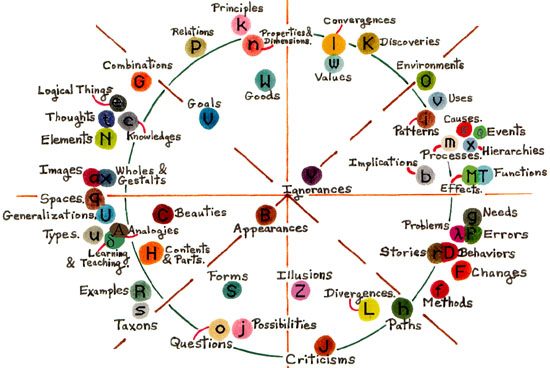
A hand-drawn Gunkel chart mapping relationships among ideas — a characteristic artifact of ideonomy.
A characteristic Gunkel chart: ideonomy maps the structure and relationships among ideas, as mathematics maps quantity.
Overview

What is Ideonomy?

Ideonomy is, by its shortest definition, the science of ideas. It is the pure and applied study of ideas and their laws, and of the use of those laws to describe, generate, compare, and investigate the ideas related to any subject, problem, or thing.

Where the established sciences each examine ideas within their own domain, ideonomy is concerned with ideas of the greatest possible generality: notions that are independent of any single discipline yet applicable across all of them. Its ambition is to treat the qualitative laws of the world as systematically as mathematics treats the quantitative ones, to make ideas themselves the subject matter of organized knowledge and methodical inquiry.

“Just as chemistry includes organized knowledge about molecules, and biology involves systematic inquiry into the nature of organisms, so ideonomy encompasses organized knowledge of, and systematic inquiry regarding, ideas.” — Patrick Gunkel, “An Introduction to Ideonomy,” Ideonomy: Introduction, Foundations, and Applications of the Science of Ideas.

Portrait of Patrick Gunkel, founder of ideonomy.
Patrick Gunkel (1947–2017), founder of ideonomy.

The project grew out of decades of work by the scholar Patrick Gunkel, who developed ideonomy's methods, divisions, and an enormous body of charts, lists, and monographs. It was compiled, hosted, and organized at MIT under the direction of Prof. Whitman Richards. The original introductions, monographs, essays, and hundreds of scanned drawings and maps remain available in full through the archive linked below.

Active Work

Related Projects / Resources

Current research, organizations, archives, and reference materials that build on, extend, or connect to the ideas gathered here.

  1. Patrick M. Gunkel Personal Archives — MIT ArchivesSpace

    The finding aid for Gunkel's papers (1984–2017) held by MIT Libraries Distinctive Collections, including biographical materials, correspondence, and ideonomy research materials.

  2. Ideonomy — Wikipedia

    Encyclopedia overview of ideonomy as a combinatorial science of ideas, with its definition, etymology, and history.

  3. Patrick Gunkel — Wikipedia

    Biographical encyclopedia entry on Patrick Gunkel (1947–2017), the independent scholar who founded ideonomy.

  4. The Gunkel Global Renaissance Project

    A registered 501(c)(3) nonprofit founded to preserve, promote, and advance Patrick Gunkel's legacy and his ideas.

  5. Armamentarium Phantasmagoria

    A recently published book and academic framework that attempts to formally systematize a toolkit for ideonomy — an “Ideonomic Armamentarium.”

  6. Guido Enthoven's “Science of Ideas” Research

    Academic research focused on the classification and generation of ideas.

  7. Grace Kind's Ideonomy Archive

    An ongoing digital-preservation project, hosted independently by Grace Kind.

    Writing · Gunkel PDFs

  8. The Beauty Project: Exploring Beauty Space with Patrick Gunkel

    A digital-humanities and mapping project that explores the concept of beauty using Gunkel's methodologies.

  9. Are.na Editorial: On Food Ontologies

    A design and culinary research exploration, featured on Are.na, that examines the structural taxonomy of food.

The Archive

Ideonomy Legacy Site

The first ideonomy website — unchanged since 2006 — is preserved as a static memorial. It holds the full set of introductions, monographs, essays, and hundreds of scanned drawings, charts, and lists.

Maintained in memory of Prof. Whitman Richards (1932–2016), whose project it was to compile and organize these documents, and of Patrick Gunkel (d. 2017), the ideonomy scholar whose lifework it preserves. The archive is kept frozen as a lasting tribute to their effort.